
BCAA vs EAA: Which Is Actually Better for Muscle Recovery?
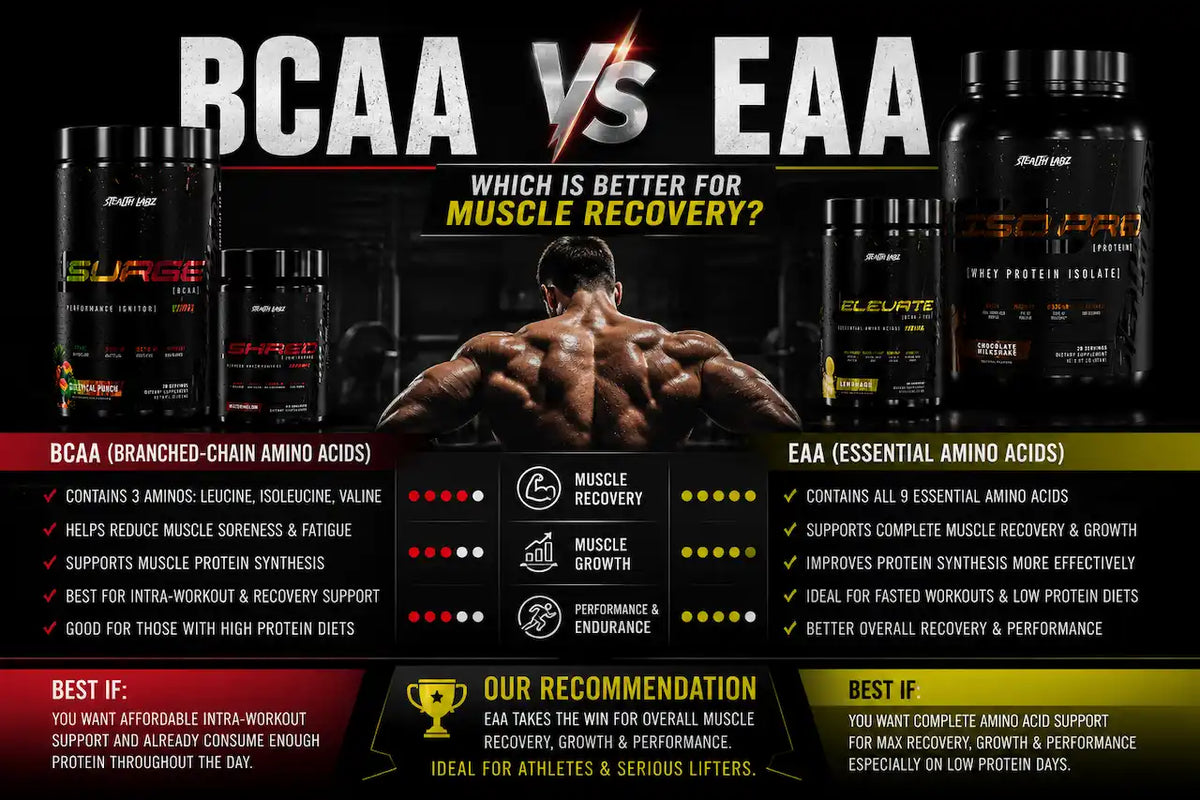
For most lifters, EAAs are the better choice for muscle recovery. BCAAs (leucine, isoleucine, valine) can reduce workout fatigue and soreness, but they only supply 3 of the 9 amino acids your body actually needs to build new muscle tissue.
EAAs supply all 9 including the 3 BCAAs which is why the research and the supplement industry have both shifted firmly toward EAA and EAA/BCAA-blend formulas over BCAA-only products in recent years.
Here's what the science actually shows, where BCAAs still make sense, and how to choose an amino acid supplement that isn't wasting your money.
What Are BCAAs?
BCAAs are three amino acids — leucine, isoleucine and valine named for their branched molecular structure. They're metabolized directly in muscle tissue rather than the liver, which is why they've long been popular as a fast, workout-specific energy source.
BCAAs can help:
-
Reduce delayed onset muscle soreness (DOMS)
-
Provide quick energy during training
-
Slow muscle breakdown during fasted or high-volume sessions
What Are EAAs?
EAAs (Essential Amino Acids) include all nine amino acids your body cannot manufacture on its own — meaning they have to come from food or supplements. That includes the three BCAAs (leucine, isoleucine, valine) plus lysine, methionine, threonine, tryptophan, phenylalanine, and histidine.
This matters because muscle protein synthesis (MPS) requires the full amino acid profile, not just three of them. Leucine can trigger the initial signal for muscle building, but without the other eight essential amino acids present, that signal doesn't translate into complete repair and growth.
What the Research Actually Says
This isn't just marketing spin — it's backed by sports nutrition research. The International Society of Sports Nutrition's 2017 position on protein specifically noted that BCAAs alone may not effectively stimulate muscle protein synthesis, because MPS requires a complete amino acid pool, not an isolated subset. This finding is a big part of why EAA and EAA/BCAA-combination formulas have largely displaced BCAA-only products among serious lifters and sports nutritionists over the past several years.
BCAA vs EAA — Key Differences
|
Feature |
BCAA |
EAA |
|---|---|---|
|
Amino acids included |
3 (leucine, isoleucine, valine) |
9 (includes all 3 BCAAs) |
|
Muscle protein synthesis |
Partial signal only |
Complete — supplies full building-block set |
|
Best for |
Intra-workout energy, reducing soreness |
Full recovery, muscle repair, plant-based diets |
|
Typical effective dose |
5–10g, 2:1:1 ratio |
8–15g, with 2–3g leucine minimum |
|
Best timing |
Pre or intra-workout |
Post-workout or anytime protein intake is low |
Benefits of BCAAs
-
Reduces perceived muscle soreness — particularly from leucine and valine
-
Convenient intra-workout energy — easy to sip during training
-
Helps limit catabolism — useful during fasted training
-
Simple, well-studied dosing — the classic 2:1:1 ratio has decades of use behind it
Benefits of EAAs
-
Complete muscle protein synthesis support — supplies every building block your body needs
-
Better recovery outcomes — research-backed advantage over BCAA-only formulas
-
More versatile use case — works pre, intra, or post-workout
-
Especially valuable for plant-based eaters — fills gaps that vegetarian and vegan diets often leave in methionine, lysine, and tryptophan
When BCAAs Still Make Sense
BCAA-only products aren't obsolete — they still have a role if:
-
You're already hitting your daily protein target from whole food or a complete protein shake, and just want a light intra-workout sipper
-
You're on a tight budget and specifically want the classic 2:1:1 ratio for training energy
-
You train fasted and want quick anti-catabolic support without a heavier EAA dose
But if your goal is genuine muscle repair and growth, not just an energy boost during training, a complete EAA (or EAA/BCAA blend) formula is the stronger choice based on the current evidence.
How to Choose a Quality Amino Acid Supplement
Not all amino acid products are dosed the same, and this is where a lot of buyers get shortchanged. Look for:
-
At least 8g total EAAs per serving, with a 2–3g leucine minimum — many budget products fall well below this
-
A complete 9-amino-acid profile, not just a BCAA blend relabeled as "aminos"
-
Added hydration support (electrolytes) if you're using it during longer training sessions
-
Transparent labeling — avoid proprietary blends that hide exact amino acid amounts
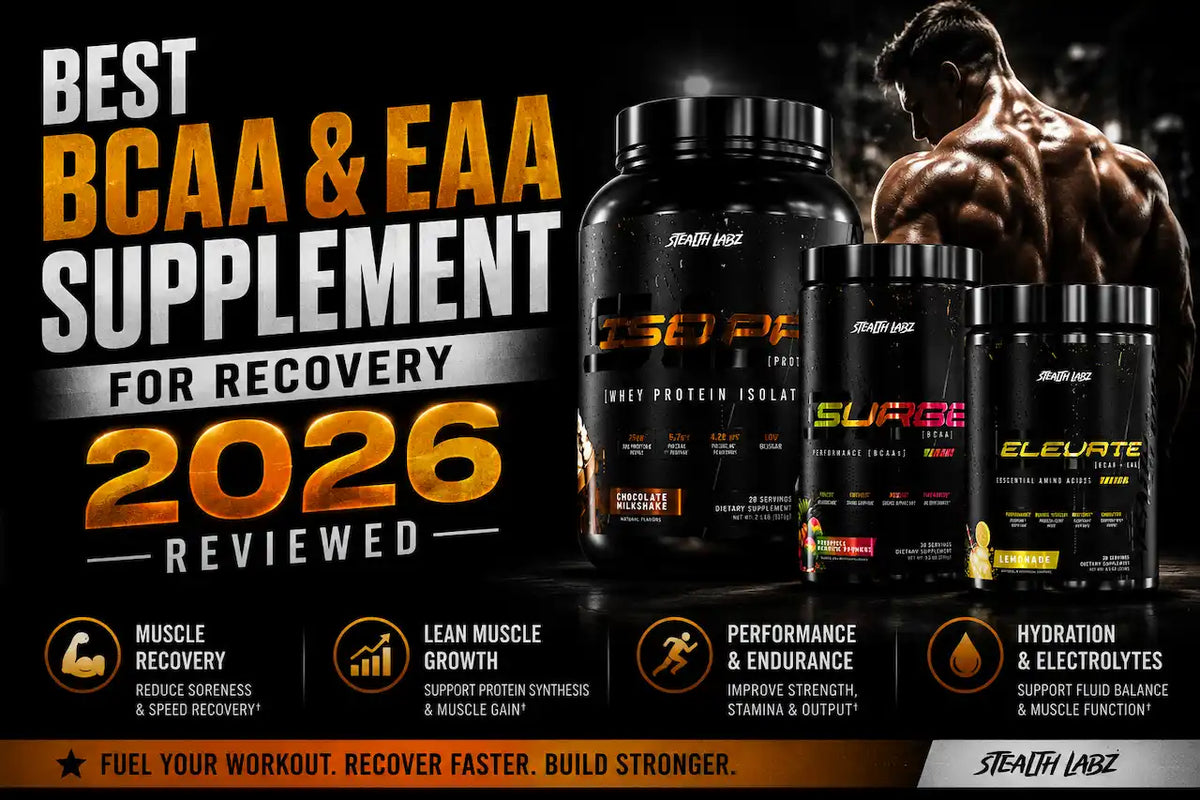
Elevate BCAA/EAA Plus by Stealth Labz is built around this exact standard a full-spectrum BCAA and EAA formula with hydration support, rather than a bare-bones BCAA-only mix, so you're not stuck choosing between energy and complete recovery support.
When to Use Each
BCAAs work best:
-
Pre-workout, for focus and quick energy
-
During fasted or high-volume training days
-
Alongside an already protein-sufficient diet
EAAs work best:
-
Post-workout, for complete muscle repair
-
If your diet has gaps in complete protein (common for vegetarians and vegans)
-
During a calorie deficit, when preserving lean muscle matters most
Best approach for most lifters: use a combined BCAA/EAA formula so you get quick intra-workout support and the complete amino profile needed for full recovery, without having to buy and stack two separate products.
Maximizing Recovery Beyond Supplements
-
Timing — take your amino formula around training, ideally post-workout if you're choosing one window
-
Hydration — amino acids are more effective when you're properly hydrated
-
Whole-food protein — supplements support your diet, they don't replace it
-
Follow label dosing — more isn't automatically better; stick to the studied range
-
Sleep — muscle repair happens overnight; amino intake and sleep work together, not in isolation
Frequently Asked Questions
Is EAA better than BCAA for muscle growth?
Yes, based on current research. EAAs supply the complete amino acid profile needed for full muscle protein synthesis, while BCAAs only stimulate partial pathways. The 2017 ISSN position stand specifically found that BCAAs alone may not effectively drive muscle protein synthesis on their own.
Can BCAAs be taken on rest days?
Yes. BCAAs can help preserve lean muscle on rest days, especially if you're in a calorie deficit or training fasted regularly. Most people get more overall benefit from an EAA formula on rest days, since it supports full-spectrum recovery rather than just anti-catabolism.
Are there side effects to BCAA or EAA supplements?
Both are generally well-tolerated at standard doses. Excessive intake can occasionally cause mild digestive discomfort — sticking to labeled serving sizes avoids this for the vast majority of users.
Do I need both a protein powder and an amino acid supplement?
Not strictly, but many lifters use both for different purposes. Protein powder covers your total daily protein target; a BCAA/EAA formula gives you a lighter, faster-absorbing option to sip during or immediately around training.
Can vegetarians and vegans benefit more from EAAs than BCAAs?
Yes. Plant-based diets often run lower in specific essential amino acids like lysine and methionine. A complete EAA supplement helps close that gap in a way a BCAA-only product can't.
Is Elevate BCAA/EAA Plus a good choice for recovery?
Yes — it combines a full amino acid profile with hydration support in one formula, which fits the "at least 8g EAAs with a real leucine dose" standard that current research points to for effective muscle recovery support.
Bottom Line
BCAAs aren't useless, but they're not the complete recovery tool many lifters assume they are. If your goal is genuine muscle repair and growth, an EAA or combined BCAA/EAA formula gives your body every building block it needs not just three of them. Use BCAAs for a light energy boost around training if you're already protein-sufficient elsewhere, and lean on a complete EAA formula like Elevate for the recovery work that actually rebuilds muscle.
Ready to close the gap in your recovery routine? Check out Elevate BCAA/EAA Plus and give your body the complete amino acid support it needs.
%20can%20reduce%20workout%20fatigue%20and%20soreness,%20but%20they%20only%20supply%203%20of%20the%209%20amino%20acids%20your%20body%20...)
Leave a comment
This site is protected by hCaptcha and the hCaptcha Privacy Policy and Terms of Service apply.