
Push Pull Legs vs Upper Lower Split: Which Builds More Muscle?
You've picked your program, hit the gym consistently and you're still stuck arguing with yourself over which split is "better." Scroll through any lifting forum or r/Fitness thread and you'll find the same debate on repeat: Push Pull Legs (PPL) vs Upper Lower split which one actually builds more muscle?
Here's the honest answer before we go any further: neither split has a magic advantage built into its name. What builds muscle is total weekly training volume, progressive overload, and recovery.
The split is just the container you organize that work in. But "just pick either one" isn't helpful advice when you're standing in the gym trying to plan your week, so let's break down exactly how each split works, who it's built for, and how to choose the one that fits your schedule and experience level.
What Is a Push Pull Legs (PPL) Split?
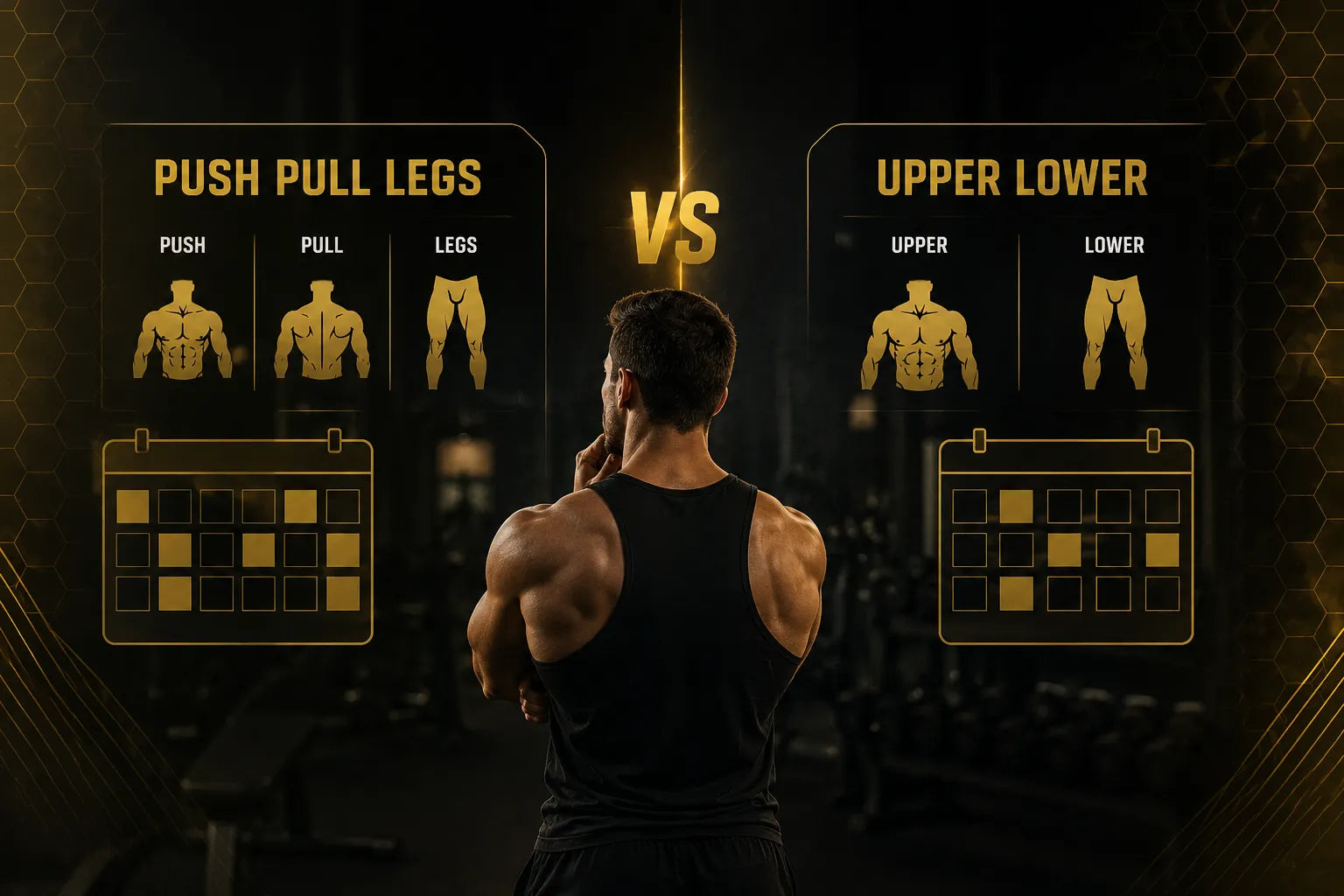
A Push Pull Legs split organizes your training around movement patterns instead of individual muscle groups:
-
Push Day: Chest, shoulders, triceps (bench press, overhead press, dips)
-
Pull Day: Back, biceps, rear delts (rows, pull-ups, deadlifts)
-
Leg Day: Quads, hamstrings, glutes, calves (squats, lunges, leg curls)
The classic version (PPL) runs the rotation twice through a 6-day week (Push, Pull, Legs, Push, Pull, Legs, Rest), hitting every muscle group twice weekly with high per-session volume.
A 3-day version exists too, but at that frequency each muscle group only gets trained once per week, which most research points to as less effective for hypertrophy than higher frequencies.
Best suited for: intermediate to advanced lifters who can commit to 5–6 training days per week and want maximum volume capacity per muscle group in a single session.
What Is an Upper Lower Split?
An Upper Lower split is simpler on paper: you alternate between upper body days and lower body days, typically across 4 training days per week.
-
Upper Day: Chest, back, shoulders, biceps, triceps
-
Lower Day: Quads, hamstrings, glutes, calves, core
Because you only need 4 days to hit every muscle group twice, Upper Lower is easier to fit around a busy schedule and gives you 3 rest/flex days to recover or catch up if life gets in the way.
Best suited for: beginners, intermediate lifters with limited training days, or anyone who needs a schedule that survives a busy week without falling apart.
Push Pull Legs vs Upper Lower Split: Head-to-Head Comparison
|
Factor |
Push Pull Legs (PPL) |
Upper Lower Split |
|
Training days per week |
5–6 (3 if reduced) |
4 |
|
Frequency per muscle group |
2x/week (at 6 days), 1x/week (at 3 days) |
2x/week (guaranteed) |
|
Volume per session |
Higher — focused on fewer muscles |
Moderate — spread across more muscles |
|
Recovery days |
1 (or fewer) |
3 |
|
Best for |
Advanced lifters, high weekly volume needs |
Beginners, busy schedules, consistency |
|
Flexibility if you miss a day |
Lower — rotation gets disrupted |
Higher — easy to reschedule |
The real difference isn't muscle growth potential, it's how the same weekly volume gets distributed and how forgiving the schedule is when life doesn't cooperate.
The Truth Most People Miss: Frequency and Volume Matter More Than the Split Name
This is the part that gets lost in most "PPL vs Upper Lower" debates: research on hypertrophy consistently shows that training each muscle group roughly twice per week, with sufficient total volume and progressive overload, is what drives growth regardless of whether you call the split PPL or Upper Lower.
If you want the deeper science on this, we break it down fully in our guide on how often you should train each muscle group for bodybuilding and in Progressive Overload Explained: The #1 Driver of Muscle Growth — because a split without progressive overload built in won't grow muscle no matter how many days you train.
In practice, both splits can deliver the same twice-weekly frequency:
-
6-day PPL: Push/Pull/Legs run twice = every muscle trained twice
-
4-day Upper Lower: Upper/Lower run twice = every muscle trained twice
The difference shows up in volume per session (PPL lets you pile more sets onto fewer muscle groups per workout) and recovery demand (PPL leaves you less room to recover between sessions unless you manage fatigue carefully).
Which Split Is Right for You? A Problem-Solving Breakdown
I'm new to lifting and can only commit to 4 days a week
Go with Upper Lower.
Lower time commitment, guaranteed twice-weekly frequency, and more built-in recovery while your body adapts to consistent training exactly what beginners need for motor learning and steady progress.
I can train 5–6 days a week and want more volume
PPL is likely the better fit.
More total sessions means you can add more sets per muscle group without any single workout becoming excessively long, which matters more as you get more advanced and need higher volume to keep progressing.
My schedule changes week to week
Upper Lower.
With 3 flexible rest days, it's far easier to shift a missed session without breaking the whole week's structure a 6-day PPL rotation falls apart fast if you miss even one day.
I want the best of both
Many intermediate lifters run a hybrid 5-day split: Push / Pull / Legs / Upper / Lower. This hits every muscle group twice per week, uses PPL's focused volume on three days, and lets the Upper/Lower days "sweep up" anything that needs extra attention while still preserving two rest days.
Recovery Is Where the Growth Actually Happens
Whichever split you choose, more training days mean more recovery demand and recovery is where the muscle-building actually happens, not the workout itself. On your rest or lighter days, active recovery can meaningfully reduce soreness and keep you consistent; our guide on active recovery workouts to reduce DOMS faster covers exactly what to do (and eat) on those days.
To support recovery between PPL or Upper Lower sessions:
-
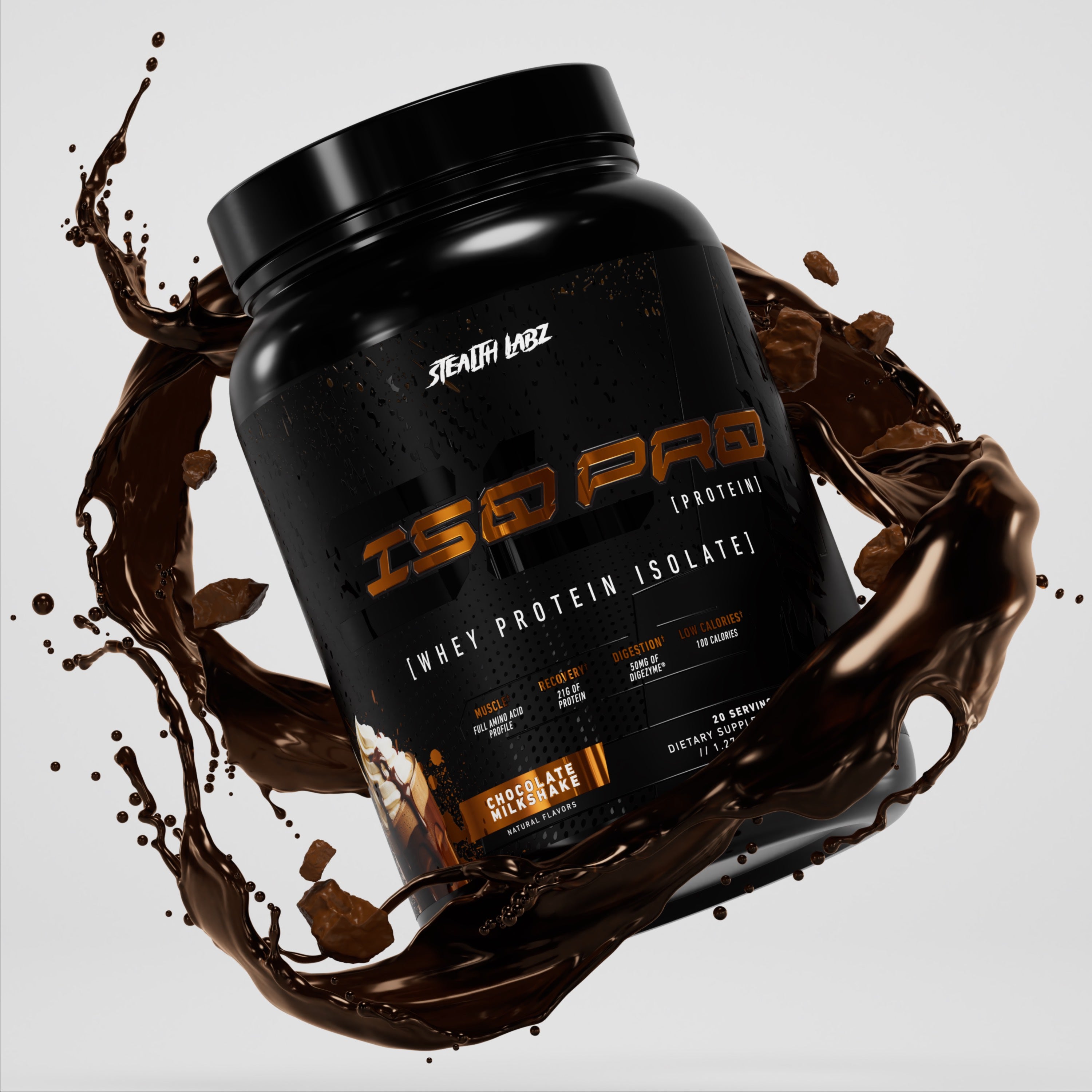
Protein intake stays non-negotiable regardless of split — ISO PRO whey protein isolate makes it easier to hit your daily target on higher-frequency training weeks.
-
Amino acids and hydration matter more on back-to-back training days (common in PPL) — Elevate BCAA/EAA Plus supports muscle protection and recovery between sessions.
-
Training energy tends to dip by day 5 or 6 of a PPL week — Surge Pre Workout helps you show up with the same intensity on your final push, pull, or leg day as your first.
-
Consistent recovery support matters across both splits — Alpha Extreme is formulated to support the hormonal and recovery side of training frequency, especially for lifters running higher-volume weeks.
Timing your supplements around training also matters — if you're using creatine as part of your stack, see our breakdown of the best time to take creatine for muscle growth to get the most out of it on both PPL and Upper Lower schedules.
Frequently Asked Questions
Is PPL better than Upper Lower for building muscle?
Not inherently. Both can produce the same muscle growth when they deliver similar weekly volume and roughly twice-weekly frequency per muscle group. PPL suits lifters who can train 5–6 days a week; Upper Lower suits those with 4 days or less consistency needs.
Which split is better for beginners?
Upper Lower is usually recommended for beginners. It requires fewer weekly sessions, still trains each muscle group twice per week, and leaves more recovery time while your body adapts to a new training stimulus.
Can I switch between PPL and Upper Lower?
Yes. Many lifters cycle between them based on schedule changes, travel, or training phase. Since both can deliver similar weekly frequency and volume, switching won't set back your progress as long as total volume stays consistent.
How many days a week should I train for muscle growth?
Most people see strong results training 4–6 days per week, provided each muscle group is trained roughly twice weekly with adequate volume and recovery. Fewer than 3 quality sessions per week typically slows progress regardless of split.
Do I need to run a 6-day PPL to see results?
No. A 3-day PPL rotation (Push, Pull, Legs, repeat) can still work, though it trains each muscle group once per week unless run twice in a 6-day week. If you can't commit to 6 days, Upper Lower will usually deliver better frequency for the same time investment.
What should I eat or take on my rest days?
Rest days still require adequate protein intake to support muscle repair, along with hydration and, for many lifters, continued creatine use. See our active recovery guide for a full rest-day nutrition breakdown.
Read More on Stealth Labz Blogs
-
How Often Should You Train Each Muscle Group for Bodybuilding? — The frequency science behind both splits.
-
Progressive Overload Explained: The #1 Driver of Muscle Growth — Why the split matters less than how you load your workouts.
-
Active Recovery Workouts: What to Do on Rest Days to Reduce DOMS Faster — Make the most of your recovery days.
-
Best Time to Take Creatine for Muscle Growth — Time your supplements around any split.
Final Thoughts
The Push Pull Legs vs Upper Lower split debate isn't really about which one is "better" — it's about which one you can train consistently, recover from properly, and progressively overload week after week. Beginners and busy lifters tend to do best on Upper Lower's 4-day structure; advanced lifters chasing higher weekly volume often prefer PPL's focused sessions. Either way, muscle growth comes down to showing up, adding load or reps over time, and giving your body what it needs to recover.
Support your training with ISO PRO for daily protein, Elevate for recovery between sessions, Surge Pre Workout for consistent training energy, and Alpha Extreme for recovery support on higher-frequency weeks.
Shop the full Stealth Labz lineup and build the stack that matches your split.
Statements regarding supplement benefits have not been evaluated by the Food and Drug Administration. Stealth Labz products are not intended to diagnose, treat, cure, or prevent any diseas.



Leave a comment
This site is protected by hCaptcha and the hCaptcha Privacy Policy and Terms of Service apply.