
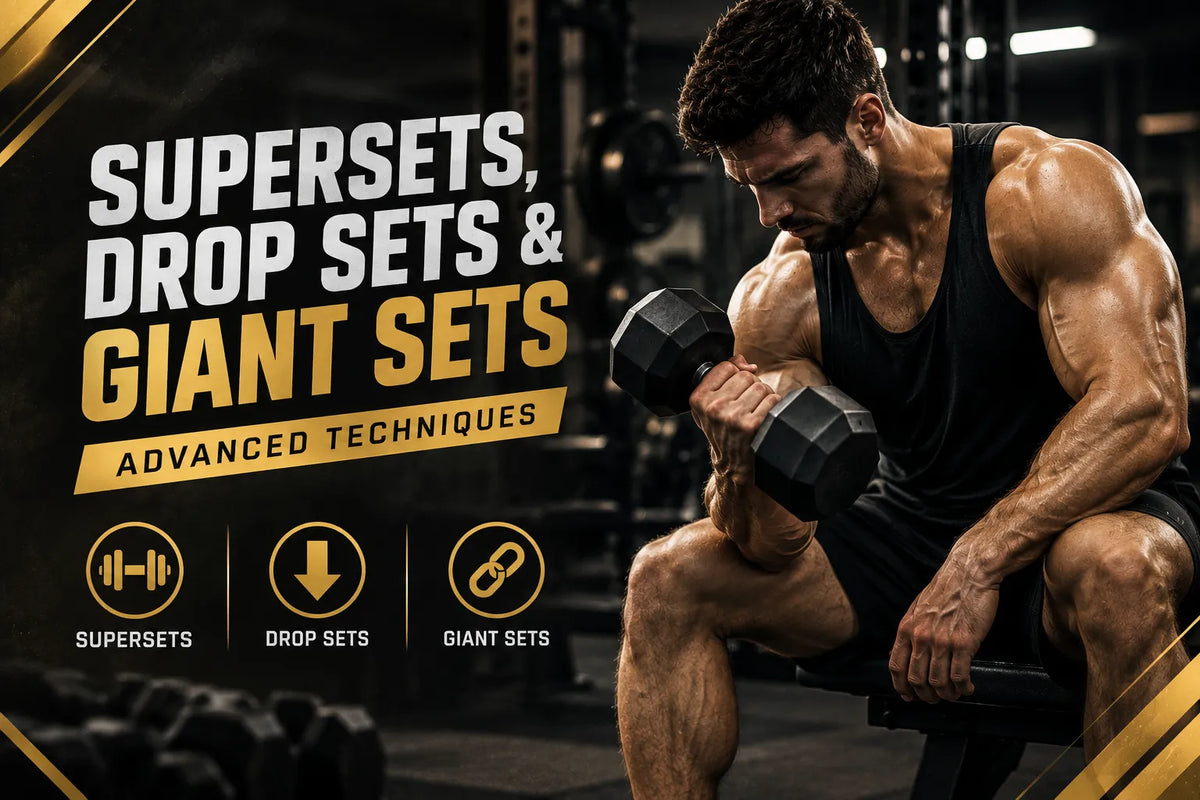
Supersets, Drop Sets & Giant Sets: Advanced Techniques for Muscle Growth
Your workout looks fine on paper. Three sets of ten, a few minutes of rest, same exercises as last month. But your arms haven't grown in weeks, your sessions are dragging past 90 minutes, and the "pump" you used to chase barely shows up anymore.
This is the point where a lot of lifters start Googling and trying to figure out if supersets, drop sets, or giant sets are the missing piece. The short answer: they can be but only if you know which one solves your actual problem, because they don't all do the same job.
This guide breaks down what each technique actually is, the research behind them, exactly how to program them into your current split, and the mistakes that turn a good intensity technique into a recipe for burnout.
What Are Supersets, Drop Sets & Giant Sets?

All three are "intensity techniques" — ways to pack more work into less time or push a muscle past the point where a normal set would end. The difference is how:
-
Superset: Two exercises performed back-to-back with no rest in between, then you rest.
-
Drop set: One exercise taken to failure, then the weight is immediately reduced and you keep going without rest.
-
Giant set: Three or more (usually four+) exercises for the same muscle group performed back-to-back with no rest, then you rest.
Think of them as points on the same spectrum: supersets are the entry point, drop sets extend a single exercise past failure, and giant sets are supersets turned up to four or five movements.
Supersets: The Time-Efficient Starting Point
A superset pairs two exercises and removes the rest between them. There are three common ways lifters structure them:
-
Antagonist supersets — pair opposing muscle groups, like biceps curls with triceps pushdowns. One muscle rests while the other works, so strength barely drops between exercises.
-
Agonist supersets — pair two exercises for the same muscle, like incline dumbbell press into cable flyes. This is closer to a mini drop set and builds significant fatigue fast.
-
Compound supersets — pair unrelated body parts (e.g., squats with pull-ups) purely to save time when you're training under a clock.
Example superset for arms:
-
Barbell curl — 10 reps
-
Overhead triceps extension — 10 reps (No rest between exercises, rest 60–90 seconds after both, repeat for 3 rounds)
Best for: Cutting workout time, breaking through boredom, adding volume to smaller muscle groups without adding 20 extra minutes to leg day.
Drop Sets: Push Past the Point Where a Normal Set Ends
A drop set means you take a set to failure, immediately reduce the weight by roughly 20–30%, and keep going with no rest — sometimes for two or three "drops" in a row.
This is one of the more heavily researched intensity techniques. Systematic reviews comparing drop-set training to traditional straight sets have found that both approaches produce meaningful, statistically similar increases in muscle hypertrophy — drop sets aren't magic, but they're a genuinely efficient way to reach the same growth stimulus in less total time, since you're accumulating fatigue and mechanical tension in a compressed window rather than across multiple fully-rested sets.
Example drop set on leg extension:
-
50 lbs to failure (~10 reps)
-
Drop to 40 lbs, immediately continue to failure (~6–8 reps)
-
Drop to 30 lbs, finish to failure (~6–8 reps)
Best for: Isolation exercises (leg extensions, lateral raises, cable curls) on machines or dumbbells where you can change the load in seconds. Drop sets are far less practical on a barbell squat or deadlift, where loading plates mid-set isn't realistic.
Giant Sets: Maximum Work, Minimum Time
A giant set is a superset stretched to four or more exercises for one muscle group, performed back-to-back with no rest until the full circuit is done. It's the technique behind training styles like FST-7 that pre-contest bodybuilders use to maximize pump and metabolic stress in a short window.
Example chest giant set:
-
Flat dumbbell press — 10 reps
-
Incline dumbbell press — 10 reps
-
Cable flye — 12 reps
-
Push-up to failure (Rest 2–3 minutes after completing all four, repeat for 2–3 total rounds)
Because giant sets stack so much volume with almost no rest, most lifters need to drop the load 20–30% below what they'd normally use for straight sets, or they simply won't be able to finish the circuit with good form.
Best for: A finishing circuit at the end of a session, pre-contest conditioning phases, or breaking a stubborn plateau on a lagging muscle group — not for your heaviest compound lifts of the day.
Comparison Table: Which One Should You Use?
|
Technique |
Exercises |
Rest Between Exercises |
Best Use Case |
Difficulty |
|
Superset |
2 |
None (rest after both) |
Saving time, adding volume |
Moderate |
|
Drop Set |
1 (with load drops) |
None between drops |
Isolation exercises, breaking past failure |
Moderate–High |
|
Giant Set |
4+ |
None until circuit ends |
Finishers, pump work, plateaus |
High |
How to Program These Into Your Split
These techniques are accessories, not your entire workout. A common structure that works well:
-
Heavy compound lift first — squats, bench, deadlift, rows — with full rest (2–4 minutes), performed as straight sets.
-
One or two intensity techniques as finishers — a superset or drop set on an isolation movement, or a giant set to close out the muscle group.
-
Limit to 1–2 muscle groups per session using these techniques — trying to giant-set every body part in one workout is a fast track to overtraining.
If you're following a structured split, these fit naturally as the last one or two movements of a session — see our guide on Push Pull Legs vs Upper Lower Split if you're still deciding on a base structure to build these into.
Because these techniques add volume and fatigue quickly, they should be layered on top of a program where progressive overload is already your main driver — not used as a substitute for it. And because a single drop set or giant set can rival the fatigue of two or three normal sets, check your current volume against our breakdown of how many sets per week you actually need before stacking these on top of an already-full program.
Fueling and Recovering From High-Intensity Training
Supersets, drop sets, and giant sets create more metabolic stress and muscle damage per session than straight sets — which means recovery becomes the limiting factor, not motivation.
-
During the session: These techniques are demanding on your energy and focus, especially in a giant set circuit lasting 60–120+ seconds without rest. A pre-workout like Surge Pre-Workout can help you keep pace through the last round instead of the circuit falling apart on exercise three.
-
Between exercises and post-session: Because these techniques push past normal failure points, amino acid support matters more than usual. ELEVATE BCAA/EAA is commonly used intra-workout to help protect muscle and reduce next-day soreness after a high-volume finisher.
-
After training: Higher fatigue sessions increase the demand for muscle repair. A fast-digesting protein like ISO PRO Whey Protein Isolate post-workout supports recovery so you're not still sore when the next session rolls around.
-
If you're building a full program around these techniques, our Muscle Building Stack bundles protein, aminos, and pre-workout support together for lifters training at higher intensity.
Since these techniques push you closer to real training fatigue, pay attention to when you need a deload week — persistent soreness, dropping performance, or dreading the gym are signs your body needs a break before you add more intensity techniques on top.
Common Mistakes to Avoid
-
Using them on every exercise, every session. Intensity techniques are seasoning, not the whole meal. Overusing them accelerates fatigue faster than it accelerates gains.
-
Sacrificing form to finish the set. Especially in giant sets, form breakdown in the final exercise is a sign the load was too heavy for the technique, not a sign you're "pushing hard enough."
-
Skipping load adjustments. Trying to use your straight-set weight in a giant set almost always means you can't complete the circuit — drop the load 20–30% going in.
-
Doing them on heavy compound lifts. Drop sets on a loaded barbell squat aren't practical or safe to load-strip mid-set. Save these techniques for machines, dumbbells, and cables.
-
Ignoring recovery. More fatigue per session means recovery — sleep, protein intake, and deload timing — matters more, not less.
Frequently Asked Questions
Are supersets, drop sets, or giant sets better for building muscle?
Research comparing drop sets to straight sets generally shows similar hypertrophy outcomes — the real advantage of all three techniques is time efficiency and added training density, not a magic growth multiplier. Straight sets with proper progressive overload remain the foundation; these techniques are accessories layered on top.
How often should I use these techniques in a week?
Most lifters do well using one intensity technique per muscle group, once or twice per week, usually as a finisher on the last exercise. Using them on every set of every session tends to accumulate fatigue faster than most people can recover from.
Can beginners do drop sets and giant sets?
Beginners can use supersets right away, but drop sets and giant sets are usually better introduced after a few months of consistent training, once technique is solid and you can accurately judge what "true failure" feels like without breaking form.
Do giant sets actually build more muscle than regular sets?
Giant sets create more total volume and metabolic stress in less time, which can be a useful stimulus for a lagging muscle group — but they aren't inherently superior to well-programmed straight sets. They're best used as a tool for specific situations (time constraints, plateaus, contest prep) rather than a default training style.
What's the difference between a superset and a giant set?
A superset uses two exercises back-to-back; a giant set uses four or more. Giant sets are essentially an extended version of the same no-rest-between-exercises concept, with more total volume and fatigue per round.
Should I lower the weight when doing these techniques?
Yes. Because there's little to no rest between exercises or drops, you typically can't handle the same load you'd use for a standard straight set — expect to reduce weight by roughly 20–30% to maintain good form through the full circuit or drop.
Read More on Stealth Labz Blogs
-
Mind-Muscle Connection: Does It Actually Improve Muscle Growth? — the foundation these techniques should be layered on top of.
-
How Many Sets Per Week for Maximum Muscle Growth — check your total volume before adding intensity techniques.
-
Deload Week Guide: When and How to Deload for Better Gains — know the signs it's time to back off.
-
Best Muscle Recovery Supplements for Men 2026 — support recovery from higher-fatigue training.
Final Thoughts
Supersets, drop sets, and giant sets won't replace a solid training program, but used correctly, they're an efficient way to add volume, break plateaus, and finish a session with a serious pump when time or motivation is running short. Start with supersets to build tolerance, add drop sets on isolation work once your form is dialed in, and save giant sets for a finisher or a specific block of training rather than every session.
Whichever technique you add, your recovery has to keep up with the extra fatigue. Fuel your sessions with Surge Pre-Workout, protect muscle with ELEVATE, and repair faster with ISO PRO — or grab it all in the Muscle Building Stack and train harder without falling behind on recovery.





Leave a comment
This site is protected by hCaptcha and the hCaptcha Privacy Policy and Terms of Service apply.